While a printed portfolio is far less important than it was 20 years ago, if you’re attending an in-person event, especially one with a portfolio showcase or critique, you should have a printed portfolio book.
Even if there’s an option to share your work on a laptop or iPad, trust me: print it out. We’re in the business of creating artwork that will eventually be printed in books. Seeing your work on paper is more professional, more polished, and more practical than fighting slow conference-center Wi-Fi while trying to pull up your website full of giant image files on a smudged iPad screen.
If you have not signed up for an in-person event, then no, you most definitely do not need a printed portfolio. Focus on your website instead.
This is my guide to making the best printed portfolio book possible, but remember, what matters most is your art, not the book it’s presented in.
Most events where you can display or bring a portfolio book will have size restrictions because of limited table space. In my experience, many events restrict books to 12 x 15 inches when closed, or 24 x 15 inches when open.
Two common book sizes fit within those limits:
A landscape-oriented 11 x 14 inch book is technically smaller than 12 x 15 inches when closed, but it opens to 28 x 11 inches. Most of the time, that may not be a problem, but stricter events may turn it away. In my opinion, it’s not worth the risk.

My favorite portfolio books are post-bound portfolios or scrapbooks with clear sleeves that allow you to slip artwork in and out. The screwpost binding makes it easy to remove or add sleeves, and the sleeves allow you to rearrange your work without needing to reprint or remount anything.
Post-bound books look beautiful, and they’re flexible enough to use year after year. You can simply switch out the artwork as your portfolio evolves.
Some post-bound books come with hinged paper sheets instead of plastic sleeves. Some illustrators prefer mounting prints to paper because they don’t like the shine of plastic sleeves. Personally, I think trimming and mounting every piece is a lot of work, and I find it much easier to update my book when nothing is glued down.
The nicest post-bound books are made by Pina Zangaro, but here are a few options at different price points:
Pioneer is a less expensive option, though the plastic sleeves may be lower quality. You should be able to replace them with better sleeves if needed.
Fixed-page presentation books are similar to post-bound books in that they usually have clear sleeves you can slip your work into. The difference is that the pockets are permanently bound into the book.
These books often come with far more pages than you need, which can leave a large block of empty pockets at the back. I find that a little annoying, but it’s not the end of the world.
The upside is price. These books can often be found for about half the cost of even the cheaper post-bound options, making them a solid budget-friendly choice.
A newer, very fancy option is to use a print-on-demand service to create a custom hardcover portfolio book. These can look amazing, and there are many ways to customize them, from colored endpapers to image-wrapped covers.
The downside is that they usually have a lead time of two weeks or more, they can be costly, and once they’re printed, they aren’t flexible. If you want to make changes, you’ll need to print an entirely new book.
Because these books can’t be reused in the same way, some illustrators add blank pages at the end for notes, messages from other event attendees, or takeaways from portfolio reviews. That can turn an old portfolio into a little time capsule from that event. If that idea appeals to you, a print-on-demand book may be a good fit.
Here are a few printers that offer books that could work:
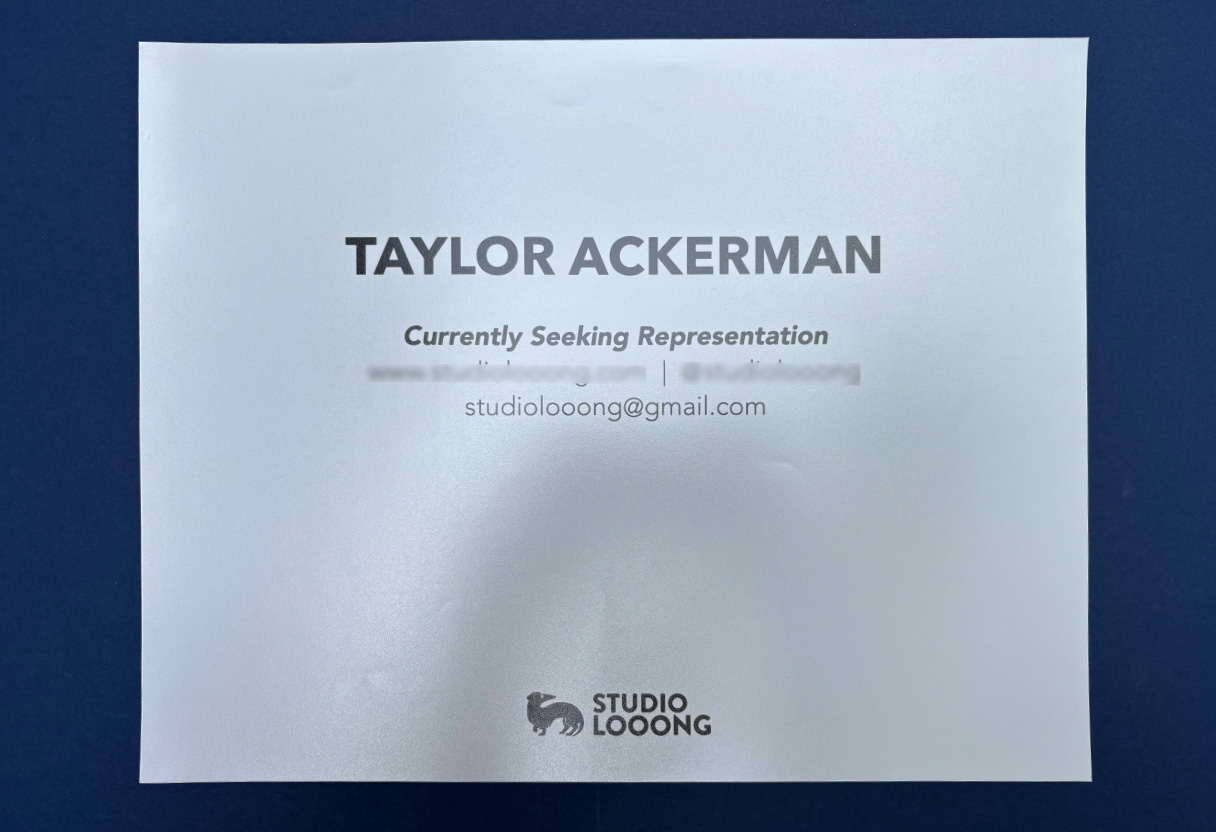
The first page of your portfolio should include your name, website, and social media handles. You can also add a line like “Represented by: _________” if you’re agented, or “Currently seeking representation” if you’re looking for an agent.
Some illustrators like to include their first image on this page. Personally, I prefer to keep it text-only, but either approach can work.

You should also make sure your book includes key contact information in case it gets misplaced. Event organizers may need your email, phone number, and address in order to return it to you.
Since I don’t necessarily want the entire event seeing my personal phone number and address, I write those details on a business-card-sized piece of paper and tape it discreetly into the back of my book.

Start by collecting high-quality images of your best and most recent work.
And this is important: never put original artwork in your portfolio. Printed reproductions only!
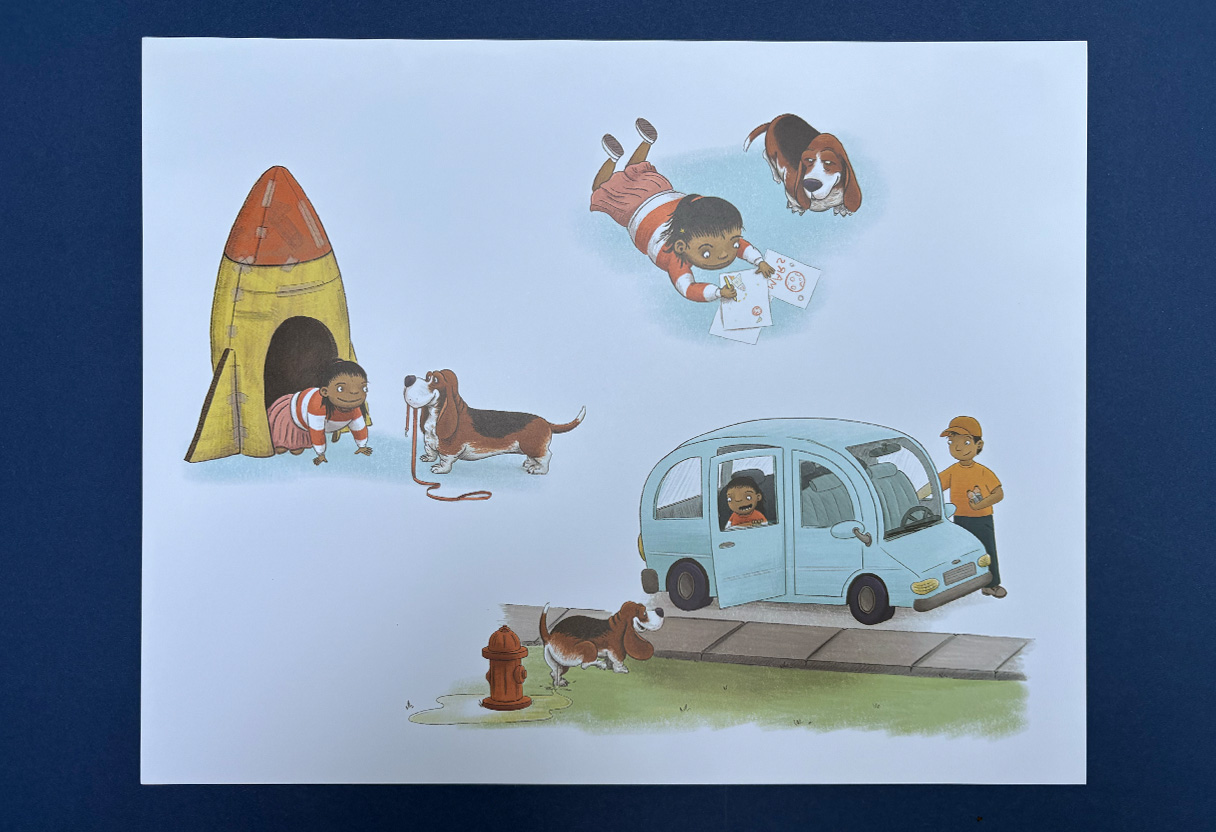
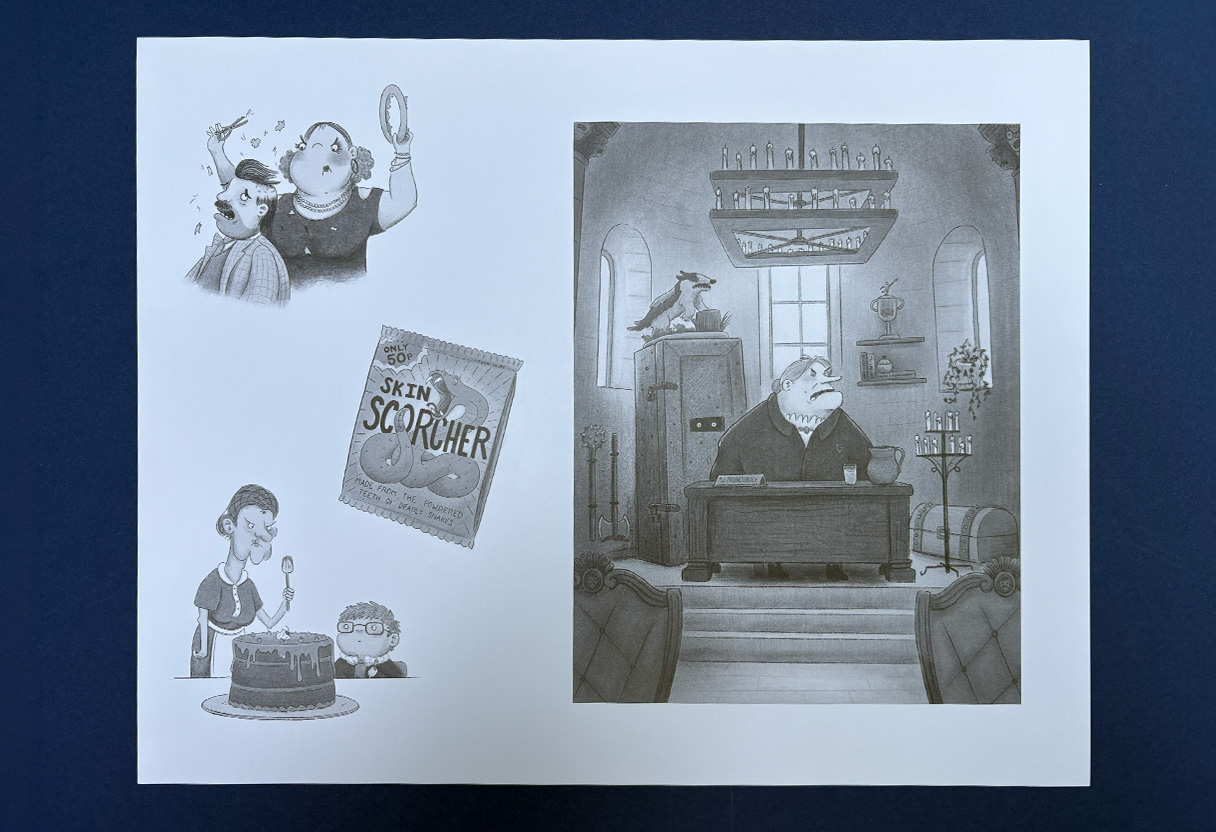
Set up a document that matches the size of your portfolio book pages, then place each piece large and centered on the page. If you have smaller spot illustrations, you can lay them out together on one page. If you have a large two-page spread, you can split it across two pages to create a spread in your portfolio book.

I tend to overprint work and decide what to cut later. Sometimes I bring extra pieces with me to events in case I want to swap in different artwork for different viewers or reviewers.
For example, if an art director mentions that they need the perfect illustration for a school bus story, I may pull out a school bus piece that didn’t originally make the cut and add it before they review my book.
I have never regretted having a few extra pieces printed and ready to go. I have regretted not printing a piece because I didn’t think I’d want to include it.
Whether your book is 8.5 x 11 inches, 11 x 14 inches, or somewhere in between, your pages can usually be printed at a large copy center on tabloid-sized paper and trimmed down to the correct size.
With printing, you get what you pay for. Choose the highest-quality printer and paper you can reasonably afford. Since you’re printing full-page images, a nicer paper that accepts ink well will be a noticeable upgrade over cheap copy paper.
A local printer that specializes in photo prints may also be able to give you better results than a big copy center using workhorse office-style Xerox machines.
I like to keep all my artwork laid out in the same orientation. If my book is portrait-oriented, I print my pieces on portrait-oriented sheets, even if the artwork itself is landscape.
Yes, that means the landscape piece has to be a little smaller. But I’ve found that it’s clunky for viewers to pick up and rotate a portfolio book 90 degrees. Most people don’t do it, especially if they aren’t sure whether they’re allowed to handle the book that way.
Once all your images are printed and trimmed to size, it’s time to decide what order they should go in.
With digital portfolios, people tend to front-load all their strongest pieces to accommodate distracted viewers with short attention spans. With printed portfolio books, I think it helps to approach the order a little differently.
I like to use what I call the “fence post method.” Your strongest, most stand-out pieces are the fence posts, and your supporting pieces are strung between them. I usually put my strongest image first to grab attention and my second-strongest image last to leave a lasting impression.
You may also have other things to consider when ordering your book. If you work in multiple styles, or if you have a selection of black-and-white pieces, it may be best to group those together into sections instead of mixing everything throughout.
This is also when I buckle down and get picky. Only the best of the best ends up in my book.
You really only need 10 to 12 strong pieces for a knockout portfolio. A portfolio with 8 excellent pieces is always better than a portfolio with 15 pretty good ones.
While my brain dump on printed portfolios may sound helpful, you don’t have to take my word as fact. Here are a few other resources I’ve found on printed portfolio books.
Most of these resources are more than 10 years old, which is part of why I felt like it might be time to compile something more current. Still, you’ll see that many of the best practices are the same ones people were sharing a decade ago.

Taylor Woolley is the author-illustrator of Earth Rover, (Familius, 2025), and the illustrator of Birthday Bash, written by Blair Northen Williamson (The Little Press, 2025).
Based in Atlanta, Georgia, Taylor creates funny, imaginative stories for children. With a pencil in hand and a sketchbook full of wild ideas, she brings readers worlds filled with humor, heart, and just the right amount of mischief.